Transforming Academia: How Transcription Supports Research and Learning
Academic work often involves more than written sources. Researchers conduct interviews, organize focus groups, record lectures, attend seminars, and collect hours of spoken information as part of their work. Turning those recordings into text can make the information easier to analyze, search, reference, and share. For researchers, educators, and students, transcription can reduce the time […]
Academic work often involves more than written sources. Researchers conduct interviews, organize focus groups, record lectures, attend seminars, and collect hours of spoken information as part of their work.
Turning those recordings into text can make the information easier to analyze, search, reference, and share. For researchers, educators, and students, transcription can reduce the time spent manually reviewing recordings and provide a practical written record of spoken content.
Scribie provides human-verified academic transcription services for research interviews, focus groups, lectures, seminars, educational videos, and classroom recordings. By combining technology with human expertise, Scribie helps academic professionals turn audio and video recordings into usable text.
1. Why Transcription Matters in Academic Work
Transcription is particularly useful when spoken information forms an important part of the research or learning process.
A researcher conducting qualitative interviews, for example, may need to analyze hours of conversations. Reading a transcript can make it easier to identify recurring themes, compare responses, organize observations, and locate specific statements.
Similarly, educators and students can use transcripts to create written records of lectures, seminars, presentations, and other educational content.
Research Interviews
Interviews are a common source of qualitative research data. A transcript gives researchers a written version of each conversation that can be reviewed and analyzed alongside other sources.
Having the interview in text form can make it easier to:
- Identify themes and recurring ideas
- Compare responses from different participants
- Locate specific statements
- Organize research data
- Annotate and code responses
- Reference quotations during the writing process
Focus Groups
Focus groups can contain multiple participants speaking throughout a discussion. A transcript with clear speaker identification can help researchers distinguish between participants and follow the development of the conversation.
This can be particularly useful when researchers need to compare opinions, identify areas of agreement or disagreement, and analyze how participants respond to one another.
Lectures and Seminars
Students and educators can also benefit from transcripts of lectures and seminars.
A written transcript provides another way to review information that was presented verbally. Students can search the text for specific topics, review difficult sections, and use the transcript alongside their notes.
Educators can also use transcripts when preparing course materials or reviewing recorded sessions.
2. Transcription Makes Research Data Easier to Work With
Working directly with hours of audio or video can be time-consuming. Researchers may have to repeatedly pause, rewind, and search through recordings to find specific information.
A transcript provides a searchable text-based version of the recording.
This doesn’t eliminate the need to listen to the original recording. Rather, it gives researchers another way to navigate their data.
For example, a researcher analyzing twenty interviews could search transcripts for recurring terms or topics before returning to the corresponding recordings for closer review.
This can make the research workflow more efficient, particularly when working with large volumes of recorded material.
3. Accuracy Matters in Academic Transcription
Academic recordings can contain specialized terminology, names, acronyms, citations, and subject-specific language.
A transcription error can change the meaning of a statement or make important information difficult to identify. Names and technical terms can be particularly challenging when they are unfamiliar to the person transcribing the recording.
For this reason, academic transcription requires attention to context as well as the words being spoken.
Scribie’s academic transcription service is designed around the needs of academic content, including technical terminology, clear speaker identification, and proper citations. The service uses certified transcribers and human quality checks to produce human-verified transcripts.
4. Human Verification and Technology
Modern transcription technology can significantly speed up the process of converting speech into text. However, automated speech recognition can still have difficulty with accents, background noise, specialized terminology, names, and multiple speakers.
Scribie uses a human-in-the-loop approach that combines technology with human expertise.
The process helps turn recordings into a preliminary transcript while experienced transcription professionals review the resulting text for accuracy, clarity, and context.
This approach is particularly useful for academic recordings where a single incorrect word or name can affect how a researcher interprets and references the material.
5. Speaker Identification and Time Coding
Academic recordings often contain more than one speaker. Interviews may involve a researcher and participant, while focus groups and seminars can involve several people.
Clear speaker identification makes the resulting transcript easier to follow and analyze.
Time coding provides another useful reference point by connecting sections of the transcript to the corresponding point in the original recording.
Scribie’s standard transcription features include automated audio time coding and speaker tracking. SRT and VTT subtitle files are also available, along with Word document exports.
These features allow researchers and educators to choose the output that best fits their workflow.
6. Transcripts Can Support Accessibility and Learning
Transcription can also make academic and educational content more accessible.
A written transcript gives students another way to engage with lectures, seminars, and recorded educational materials. It can be particularly useful for reviewing complex topics or revisiting information after a class or presentation.
Transcripts can also serve as the foundation for captions and subtitles, helping educational content reach audiences who may prefer or require text-based access.
For educators, having a transcript can provide additional material that can be edited into study resources, summaries, or other course materials.
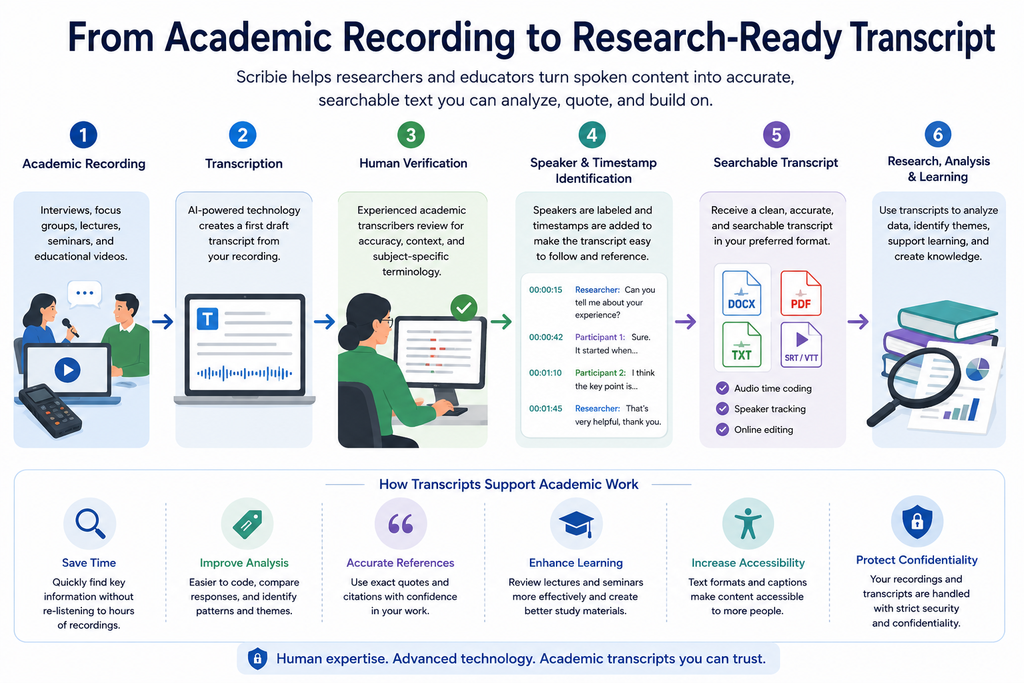
7. From Recording to Research Data
A recorded interview does not automatically become useful research data simply because it has been transcribed.
Researchers still need to review their transcripts, determine how they will code or analyze their data, and verify important quotations against the original recording.
Transcription is one part of the broader research workflow.
A typical process might look like this:
Record → Transcribe → Review → Code or Analyze → Reference
The transcript provides the bridge between the original recording and the researcher’s analysis.
For large research projects, establishing a consistent transcription workflow can also make it easier to manage recordings from multiple participants and maintain consistency across the dataset.
8. Protecting Sensitive Academic Information
Research recordings can contain confidential interviews, participant information, unpublished findings, and other sensitive material.
Researchers should therefore consider confidentiality and data-handling practices when selecting a transcription provider.
Scribie’s academic transcription service maintains strict confidentiality and provides secure handling of academic recordings. The service is designed for researchers, educators, and other academic professionals working with potentially sensitive audio and video content.
9. Academic Transcription for Different Types of Recordings
Scribie’s academic transcription service supports a variety of academic and educational recordings, including:
- Research interviews — Transcribe conversations with study participants for qualitative analysis.
- Focus groups — Create searchable records of group discussions with speaker identification.
- Lectures and seminars — Turn recorded educational sessions into written material for review and reference.
- Classroom recordings — Create transcripts that can support students and educators.
- Educational videos — Produce written versions of instructional content.
- Other academic recordings — Transcribe presentations, discussions, and other research or educational material.
Scribie supports common audio and video formats, including MP3, WAV, M4A, FLAC, MP4, MPEG, and MOV.
10. Why Choose Scribie for Academic Transcription?
Scribie provides academic transcription starting at $0.80 per minute for transcription only. Additional charges may apply when specific formatting or templates are requested.
Standard features include:
- Human-verified transcription
- Audio time coding
- Speaker tracking
- SRT/VTT subtitle files
- Word document export
- Support for audio and video files
- Online transcript editing
For projects with additional requirements, Scribie also offers options such as Precision Verbatim, Priority Processing, and support for noisy or accented audio.
For larger research teams and academic organizations, enterprise options are also available.
Make Academic Research More Efficient With Transcription
Research often requires working with large amounts of information. When that information comes from interviews, focus groups, lectures, seminars, or other recordings, transcription can turn spoken content into a format that is easier to search, review, analyze, and reference.
A transcript does not replace the researcher’s judgment or analysis. Instead, it provides a practical written representation of the original recording that can become an important part of the research workflow.
Scribie combines advanced transcription technology with human expertise to provide human-verified academic transcripts for researchers, educators, and students.
Whether you are analyzing research interviews, transcribing a focus group, preparing lecture materials, or creating a written record of an academic event, Scribie can help turn your recordings into usable text.
Get started with Scribie and turn your academic recordings into searchable, usable transcripts.
Comments (0)
No comments yet. Be the first to share your thoughts!