Where AI Falls Short: The Case for Human Intervention in Court Transcription
The legal profession, especially court transcription, has always been built on precision. A misplaced word in a contract, a misheard name in a deposition, or a missed timestamp in a court transcript can ripple across years of litigation. When artificial intelligence entered the picture — promising faster turnaround, lower costs, and seamless scalability — the […]
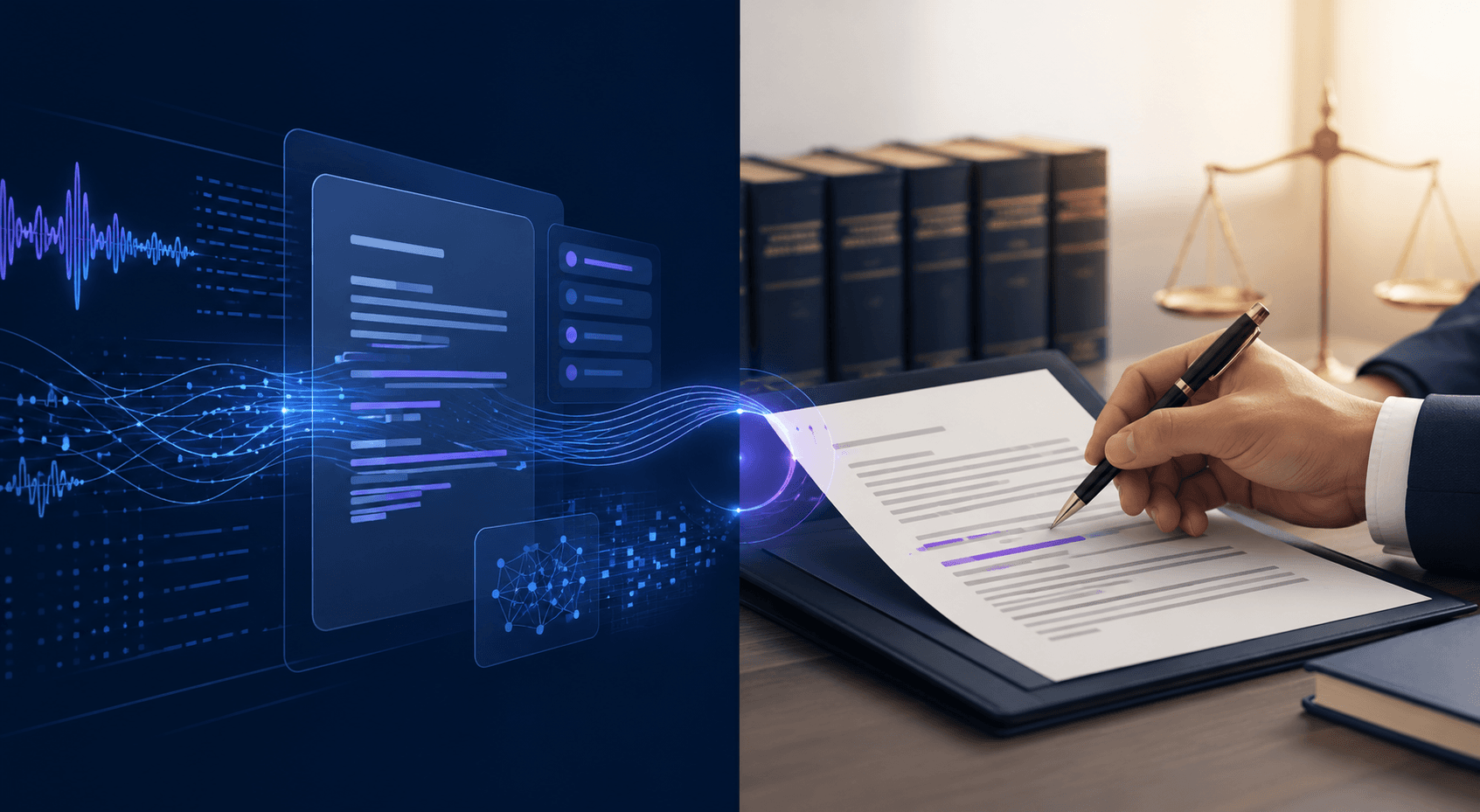
The legal profession, especially court transcription, has always been built on precision. A misplaced word in a contract, a misheard name in a deposition, or a missed timestamp in a court transcript can ripple across years of litigation. When artificial intelligence entered the picture — promising faster turnaround, lower costs, and seamless scalability — the legal industry responded with cautious optimism and quiet dread.
That tension is entirely justified. AI does not solve the problem of court transcription and legal documentation. It reframes it. Understanding exactly where the machine excels — and where it quietly unravels — is the key to building workflows that hold up under scrutiny.
The Promise AI Delivered On
AI-powered transcription has genuinely transformed what is possible at scale. A 10-hour deposition recording that once required days of human effort can now produce a rough transcript in minutes. AI can simultaneously process audio files from dozens of courtrooms, law firms, and compliance departments. Legal departments can now move faster, respond sooner, and manage larger dockets without proportionally growing their support teams. That throughput is not trivial.
Automated tools also bring consistency to mechanical tasks. AI performs formatting, time coding, speaker tagging, and text generation reliably and repeatedly without fatigue. For high-volume, lower-stakes work, the efficiency gains are real and measurable.
Where Does AI Get Court Transcription Wrong — and Why Does It Matter?
Legal language is not general language. It is a specialized dialect with its own vocabulary, its own cadence, and its own consequences for error. This is precisely where AI begins to crack.
Proper nouns are a persistent failure point:
AI models train on broad datasets. They do not learn the specific names of parties, judges, expert witnesses, or local jurisdictions that populate any given case. “Kowalczyk” becomes “Kowalchik.” “Nguyen” appears three different ways in the same transcript. A pharmaceutical compound gets misspelled in ways that change its identity entirely. In legal documents, these are not typographic nuisances — they are material errors.
Accents, dialects, and non-native speakers challenge every model:
AI systems routinely struggle with witnesses testifying in English as a second language, deponents with thick regional accents, and speakers who choose words carefully with deliberate pauses. The transcripts may look fluent at first glance, but they contain substitutions that subtly or dramatically alter what the speaker actually said.
Cross-talk and overlapping speech create compounding errors:
In depositions, hearings, and multi-party negotiations, speakers interrupt, finish each other’s sentences, and talk simultaneously. AI models produce clean linear output. When reality does not cooperate, the model makes choices — and those choices are often wrong. A human reviewer will not catch these errors without listening directly to the audio.
Legal context requires judgment, not pattern-matching:
When a witness says “I don’t recall” versus “I don’t remember” versus “I have no recollection of that,” a human transcriptionist recognizes these as distinct and deliberate phrasings. Legal counsel or trained witnesses choose these words carefully. Instead, an AI optimizes for likely word sequences and may normalize language that was never meant to be normalized.
The Hidden Problem: Speaker Identification in Multi-Party Legal Proceedings
One of the most underappreciated challenges in court transcription is not what someone said — but who said it. In a deposition with two attorneys, a client, and a witness, accurate speech attribution matters as much as capturing the speech itself. Mis-attributed testimony is not just a formatting error. It can fundamentally misrepresent the record.
AI speaker diarization — the technology that segments and labels speakers — has improved significantly. But it remains unreliable in exactly the conditions that legal proceedings create: variable audio quality, multiple speakers at different distances from the microphone, participants joining by phone, and proceedings that stretch across hours as background conditions change.
How Does Scribie Handle Speaker Identification?
At Scribie, our transcribers use structured methods to distinguish between speakers with confidence. They use the Notes feature to record the names of each speaker along with anything that distinguishes them — voice, tone, accent, and pronunciation patterns. If a speaker consistently pronounces a word in a unique way, the transcriber logs that detail and uses it as a consistent identifier throughout the transcript.
For files that include video, this process becomes even more robust. Transcribers identify speakers by visual cues: clothing color, seating position, distinguishing physical features, and other contextual markers on screen. They apply the same systematic, note-based approach — building a reference profile for each speaker and consulting it throughout the transcription.
Many clients do not have video recordings or prefer not to upload them, often due to privacy concerns. In those cases, transcribers rely on audio-only identification through careful listening, cross-referencing with case materials, and documented voice profiling. It is slower. It requires more skill. And no automated system can replicate it.
This is a fundamental constraint that AI improvement will not fully eliminate in the near term. The problem is not just computational — it is contextual. Knowing who is speaking in a court transcription requires understanding the proceeding itself.
Rethinking the Workflow: Collaboration, Not Competition
Many legal operations teams frame AI and human transcriptionists as alternatives — a choice between speed and accuracy. A more useful frame is sequential collaboration: AI handles what it does efficiently, and humans step in precisely where the machine’s limitations create risk.
In practice, this means four things.
AI handles the first pass:
Automation is appropriate for raw transcription, initial time-coding, and formatting structure. The goal is a rough draft that reduces the burden on human reviewers — not a finished product.
Human review is non-negotiable for anything entering the legal record:
Court filings, depositions, compliance documentation, and client communications all require a human reviewer. That reviewer must understand the legal context, have access to case materials, and exercise judgment when the audio is ambiguous or the AI output does not match what was said.
Speaker identification is always a human task:
Given the stakes of mis-attribution in legal proceedings, a human must verify speaker diarization. That person needs full context — who the parties are, what roles they play, and what their voices sound like.
Quality assurance must be built in, not bolted on:
The worst version of an AI-assisted court transcription workflow is one where speed becomes the priority and human review becomes a rubber stamp. The volume efficiency that AI creates can pressure teams to reduce oversight — which is precisely backwards.
Can You Trust a Court Transcript That AI Produced?
Legal documents, signed affidavits, and certified transcripts carry weight that rough notes do not. That weight comes from accountability — from a human being who has reviewed, verified, and stands behind the record.
AI systems carry no professional liability. They hold no certifications. Opposing counsel cannot depose or cross-examine them. When someone challenges a transcript in court, how it was produced — by whom, under what process, with what level of oversight — becomes legally relevant. An organization with a documented, human-verified workflow stands in a fundamentally different position than one that relied entirely on automated output.
This is not an argument against using AI in legal workflows. It is an argument for understanding what AI can and cannot confer — and for being deliberate about where human judgment is not optional, but essential.
Looking Ahead: What “Good” Looks Like?
The legal industry is moving toward AI integration whether individual firms are ready or not. The question is not whether to adopt these tools. It is how to adopt them in ways that preserve the accuracy and accountability that legal work demands.
The organizations that get this right are not the ones that automate the most aggressively. They are the ones that are clearest about the limits of automation — and most deliberate about applying human expertise where it matters most: in context, in judgment, and in accountability.
Court transcription workflows should not optimize for speed alone. They should optimize for defensibility — for the ability to stand behind every document, every transcript, and every record produced.
That standard requires both AI and human contribution. And it requires knowing, precisely, what each one is for.
Why Scribie?
Scribie’s human-in-the-loop model is built precisely for this. Our transcribers have experience specifically in legal terminology, court formatting standards, and the kind of contextual judgment that AI cannot replicate. Every transcript goes through a rigorous multi-step quality assurance process, giving you a guaranteed accuracy of 99% or higher — because in court transcription, the margin for error is not 1%.
If you are a court reporter, law firm, or legal operations team looking for a legal transcription partner you can stand behind, get in touch with us.
AI is an indispensable tool which aids in reducing time and helps in scaling. But human intervention is a necessary step which adds the most important layer of trust to this process.
Comments (0)
No comments yet. Be the first to share your thoughts!