Precision and Efficiency in Legal & Courtroom Transcription
Legal proceedings generate a tremendous amount of information. From courtroom hearings and trials to depositions and examinations under oath, every statement can become an important part of the legal record. Having an accurate written record of these proceedings makes it easier for attorneys, court reporters, legal professionals, and other stakeholders to review testimony, locate important […]
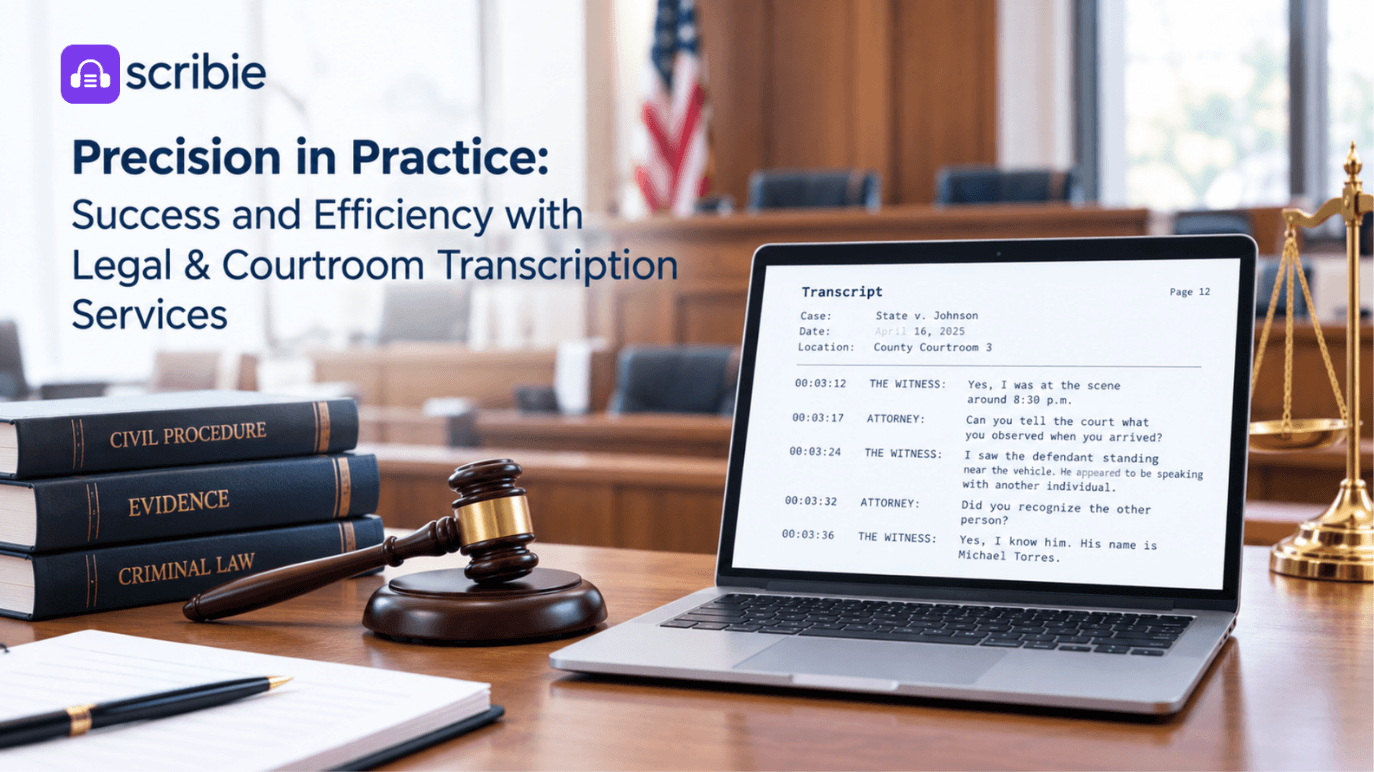
Legal proceedings generate a tremendous amount of information. From courtroom hearings and trials to depositions and examinations under oath, every statement can become an important part of the legal record.
Having an accurate written record of these proceedings makes it easier for attorneys, court reporters, legal professionals, and other stakeholders to review testimony, locate important statements, prepare for upcoming proceedings, and manage case documentation.
This is where legal and courtroom transcription services can make a significant difference.
Instead of spending hours listening to recordings and manually creating transcripts, legal professionals can use a professional transcription service to turn recorded proceedings into searchable, organized text.
But legal transcription requires more than simply converting speech into words. Accuracy, context, terminology, formatting, and confidentiality all matter.
Why Accurate Courtroom Transcription Matters
Courtroom proceedings can move quickly. Multiple speakers may participate, legal terminology can be complex, and important statements may occur during moments of rapid questioning or discussion.
A transcript that contains errors, missing words, incorrectly identified speakers, or inconsistent formatting can make it harder to review what actually occurred.
An accurate transcript provides a reliable written reference that can help legal teams:
- Review testimony more efficiently
- Locate important statements
- Prepare for hearings, trials, and examinations
- Organize case-related documentation
- Search through lengthy recordings more easily
- Share written records with authorized members of a legal team
- Reduce the amount of time spent reviewing recordings
For law firms and court reporting professionals handling significant volumes of recordings, professional transcription can also help reduce administrative workload.
What Types of Legal Proceedings Can Be Transcribed?
Legal transcription can be useful across many types of recorded proceedings and legal matters.
Courtroom Hearings and Trials
Courtroom proceedings can contain extended discussions between judges, attorneys, witnesses, and other participants. A written transcript makes the recorded proceeding easier to review and reference.
Depositions
Depositions often contain detailed testimony that attorneys may need to revisit throughout a case. A properly prepared transcript allows legal professionals to locate testimony without repeatedly searching through the original recording.
Examinations Under Oath
Insurance and other legal matters may involve examinations under oath (EUOs). These proceedings can benefit from an organized transcript that preserves the testimony and relevant exchanges.
Administrative and Motion Hearings
Hearings can involve multiple participants, legal arguments, testimony, and procedural discussions. Transcription provides a searchable written record for subsequent review.
Other Legal Recordings
Legal teams may also need transcripts for recorded interviews, witness testimony, arbitration, mediation, and other case-related recordings.
The exact formatting requirements can vary depending on the type of proceeding and the needs of the organization. That is why having the ability to use a standard legal template or provide a custom template can be important.
What Makes Legal Transcription Different?
A general transcript and a professionally formatted legal transcript are not necessarily the same thing.
For a basic transcription, the primary objective is to accurately convert the recorded speech into text.
Legal transcription can require an additional layer of organization and formatting. Depending on the requested output, a legal transcript may include elements such as:
- Case information
- Speaker identification
- Attorney appearances
- Witness information
- Examination sections
- Testimony indexes
- Exhibit references
- Specific spacing and pagination
- Other formatting requirements specified by the customer
The appropriate format depends on the proceeding and the customer’s requirements.
This is why Scribie allows legal customers to provide their own template and formatting instructions. The goal is to produce a transcript that fits the workflow in which it will be used.
Human-Verified Accuracy and Context
Legal recordings often contain terminology, names, references, and conversational details that require contextual understanding.
Automated speech recognition can produce a transcript quickly, but raw automated output may contain errors that become particularly problematic in legal content.
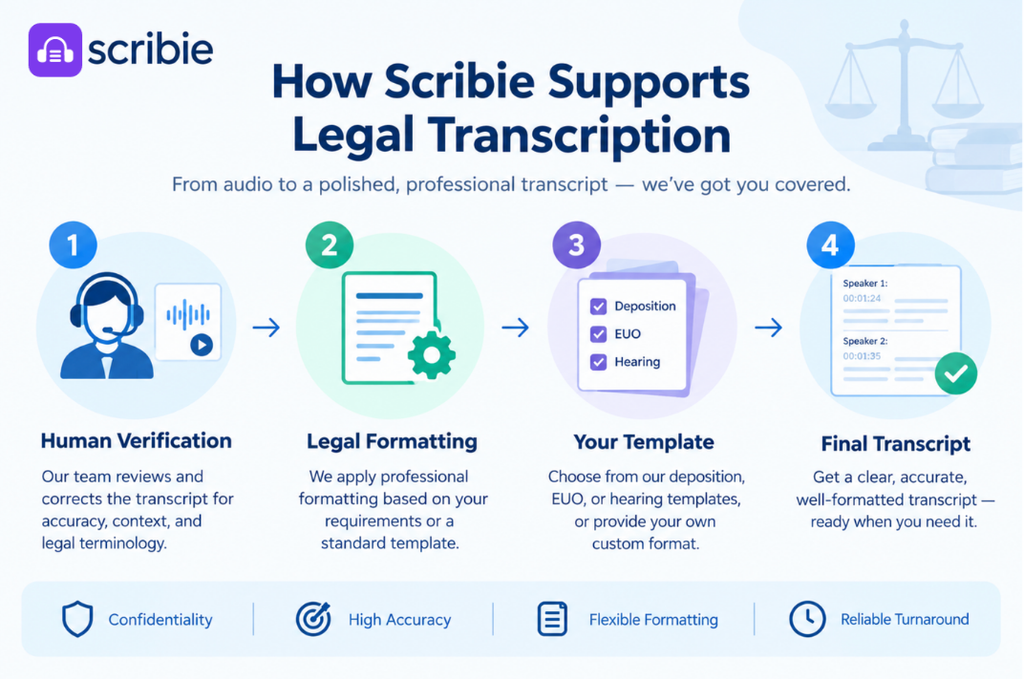
Scribie’s approach combines AI-powered transcription technology with human verification. This helps identify and correct transcription errors while preserving the meaning and context of the recorded conversation.
Scribie’s legal transcription service is designed for recordings involving legal terminology and documentation standards, with a focus on producing accurate, professionally prepared transcripts.
Confidentiality Is Essential
Legal recordings frequently contain sensitive information about individuals, organizations, disputes, testimony, and ongoing cases.
That makes confidentiality an essential consideration when choosing a transcription provider.
Scribie maintains confidentiality and security protocols for legal documents and handles legal transcription with the sensitivity expected of this type of content.
For legal teams, the objective is not simply to obtain a transcript. It is to have a reliable written record while maintaining appropriate safeguards for the underlying information.
Choose a Standard Template or Provide Your Own
Different legal professionals may have different formatting requirements.
Scribie provides standard formats for several common legal use cases, including:
Deposition Template
Designed for sworn deposition testimony, the standard deposition format includes elements such as case information, appearances, indexes, stipulations, and proceedings.
EUO Template
The Examination Under Oath template is designed for insurance examinations and includes areas for claim information, appearances, oath-related content, indexes, and testimony.
Hearing Template
The hearing format is designed for administrative and motion hearings and includes elements such as jurisdiction information, judge or hearing officer designation, appearances, and multi-witness examination indexes.
Scribie also allows customers to provide their own template and formatting preferences. This is particularly useful for law firms, court reporting agencies, and organizations that already have an established transcript format.
Transcription Only vs. Custom Legal Formatting
One of the most important distinctions to understand when ordering from Scribie is the difference between transcription and custom formatting.
Transcription Only
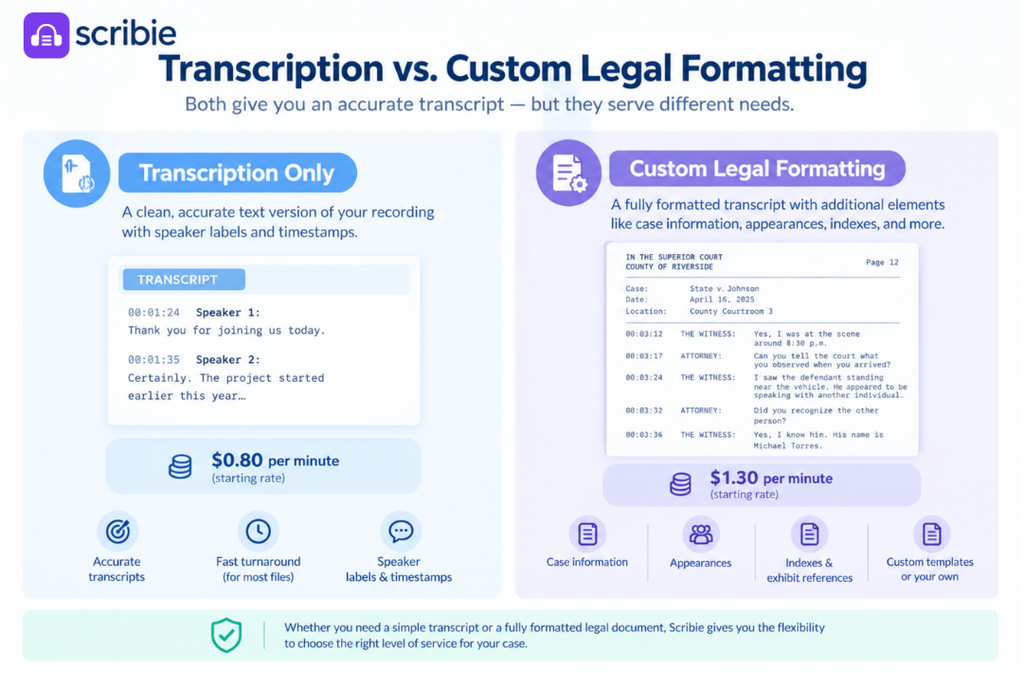
If you primarily need an accurate written version of your recording, you can order transcription without custom legal formatting.
Scribie’s current standard transcription rate starts at $0.80 per minute.
Transcription + Custom Formatting
If you need the transcript prepared according to a specific legal format or template, Scribie offers transcription combined with custom formatting.
The current starting rate for formatted legal transcripts is $1.30 per minute, with additional charges potentially applying depending on the requested formatting or template requirements.
This approach allows customers to choose the level of preparation that matches their needs rather than paying for specialized formatting when a standard transcript is sufficient.
Built for Individual Professionals and Legal Teams
Legal transcription needs can vary considerably.
A solo professional may only need occasional transcription, while a court reporting agency or legal organization may need transcripts regularly and at higher volumes.
Scribie supports both types of customers.
For recurring or higher-volume work, legal teams and agencies can contact Scribie to discuss a custom plan based on factors such as volume, formatting requirements, and preferred turnaround time.
This can make transcription easier to integrate into an existing legal workflow.
A More Efficient Way to Work With Recorded Proceedings
Listening to lengthy recordings repeatedly can consume valuable time that legal professionals could spend on case preparation and other responsibilities.
Professional transcription turns those recordings into searchable written documents that are easier to review, reference, and organize.
For legal professionals, the value goes beyond saving time. A well-prepared transcript provides a practical way to work with the information contained in a recording.
Whether you need a transcript of a deposition, hearing, examination under oath, or another legal proceeding, the right transcription solution can help make the process more efficient.
Legal Transcription Services from Scribie
Scribie provides human-verified legal transcription and custom formatting for legal professionals, court reporting agencies, and organizations working with recorded legal proceedings.
You can choose between transcription-only services or transcription with custom formatting, depending on your requirements. Scribie also provides standard deposition, EUO, and hearing templates, while allowing customers to submit their own templates and formatting instructions.
With legal transcription starting at $0.80 per minute for transcription-only and $1.30 per minute for transcription with custom formatting, you can select the service that best fits your workflow.
If you regularly work with courtroom recordings, depositions, hearings, or other legal proceedings, Scribie can help turn those recordings into accurate, professionally prepared transcripts.
Learn more about Scribie’s Legal Transcription Services and get started today.
Comments (0)
No comments yet. Be the first to share your thoughts!